
The Tehran Shockwave: Day 3 — A Nation in Limbo and a World on Edge
The map of the Middle East has been redrawn. With a new "Interim Council" in power in Tehran and oil prices surging as the work week begins, we are looking at the most consequential geopolitical shift of 2026. 3 things you need to know about the aftermath of #OperationEpicFury and the $100 oil threat.
MONDAY NOTEFEATURE
3/2/20261 min read
As of this morning, Monday, March 2, the smoke over Tehran has begun to clear, revealing a country and a region that look nothing like they did 72 hours ago. Following the confirmation of Ayatollah Khamenei’s death in "Operation Epic Fury," the world is now watching a high-stakes transition of power and a volatile reaction in the global markets.
Here are the 3 notes you need for your Monday morning:
1. The Interim Leadership Council
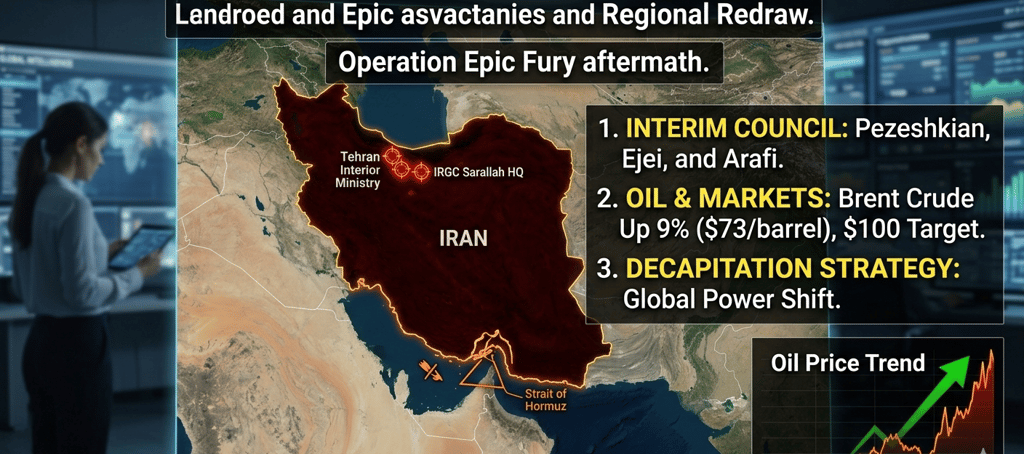
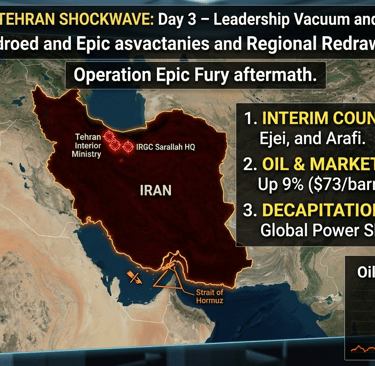
Tehran has officially moved into a "Leadership Council" phase. Under the Iranian constitution, a trio consisting of President Masoud Pezeshkian, Judiciary Chief Mohseni Ejei, and senior cleric Ayatollah Alireza Arafi has taken control. Arafi, a trusted Khamenei insider, is being viewed as the likely frontrunner for the permanent Supreme Leader role. While the regime aims for "continuity," reports of defections within the IRGC suggest the transition is anything but smooth.
2. The Cost of Conflict: Oil & Casualties
The human and economic toll of the weekend is becoming clearer.
Casualties: U.S. Central Command (CENTCOM) confirmed this morning that three U.S. service members were killed and five seriously wounded during the initial waves of the operation.
Oil Shock: As markets opened today, Brent crude jumped 9% to $73 a barrel, with analysts warning of a surge toward $100 if the Strait of Hormuz remains contested. Iran has reportedly begun retaliatory strikes on maritime traffic, hitting a vessel near the UAE.
3. The "Decapitation" Strategy
It is now clear that "Operation Epic Fury" was a systematic "decapitation" campaign. Beyond the Supreme Leader, the strikes successfully targeted the IRGC Sarallah Headquarters—the nerve center for internal security in Tehran. This was a dual-purpose move: to neutralize Iran’s command-and-control and to provide an opening for the domestic opposition to rise up. Protests are currently being reported in multiple provinces despite a heavy internet blackout.
The Bottom Line: The "Announce and Negotiate" era is over. With Trump signaling a willingness to talk only to "what is left" of the leadership, and Iran vowing "Epic Revenge," the next 48 hours are the most dangerous the Middle East has seen in decades.